 
Chapter 2
Department of Sanitation, New York City (DSNY)
Escalator-Loader Refuse Collection Body
In between the first self-loading refuse bodies which appeared in the late 1920s, and the first American compactor trucks of the late 1930s lies an almost forgotten chapter in evolution of the American refuse truck, the escalator-loader designed by the New York City Department of Sanitation (DSNY). For nearly a decade, these were the mainstay of the Department fleet, then the largest of any city in world, and would have a profound influence on equipment purchased by the DSNY well into the 1960s. Though designed by the DSNY, this new unit was to be built by America's two biggest truck body manufacturers, Gar Wood Industries and The Heil Company. These rivals competed for DSNY contracts, building nearly identical versions between 1937 and about 1947. Though relatively short-lived, the sheer numbers of escalator-loaders ordered by the Department may have single-handedly jump-started the U.S. refuse body industry, and set the stage for intense technical competition among the major manufacturers.
Prior to the DSNY escalator-loader, neither Gar Wood nor Heil had yet fielded a mechanized refuse body of their own design. Heil probably had a slight edge, having built some Colecto bodies under contract since the late 1920s. These didn't compact refuse, but had a hydraulically lifted loading trough that emptied into an enclosed body. These so-called bucket loaders eliminated many of the dangers of refuse collection, mainly the positioning of a man atop the truck (known as a "swamper") to receive barrels tossed up from street level. The Leach Company introduced a bucket loader of their own design in 1932, the Refuse Getter, which was the first of that company's famous refuse bodies. The drawback to these early bucket loaders was their small capacity, usually 6-10 cubic yards, which made bulky rubbish collection difficult if not impossible. They were, however well suited for the collection garbage and ash, dense refuse that required no compaction. In many cities, they often worked alongside the bigger open-type refuse trucks.
By 1936, the DSNY fleet of 2,200 vehicles was obsolete and worn out, with few new purchases having been made in nearly five years. New management made the first order of business the replacement of 1,800 trucks that were dedicated to daily refuse collection. The Department specified an in-house design, for an all-steel, hand-loaded body in two sizes. The largest were of 24-cubic yard capacity and mounted on a General Motors (GMC) truck chassis, of which 315 units were ordered. These were fully enclosed, with three loading doors on either side. The smaller trucks carried 12-cubic yards, and were for use in alleys and areas where a short turning circle was necessary. 105 of these smaller bodies were purchased and went on White chassis.
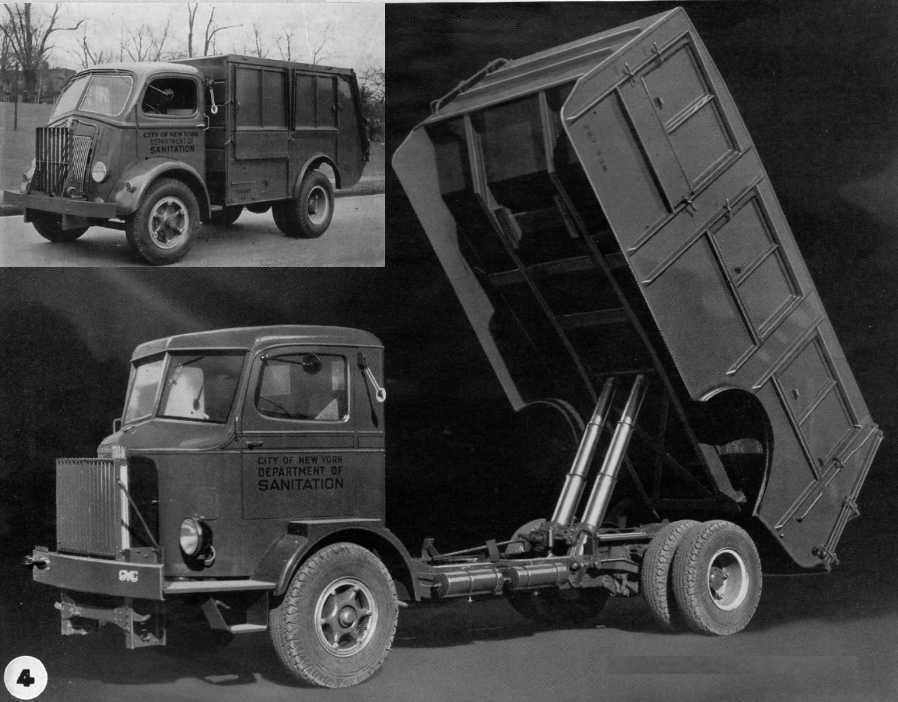
Above: 1936 DSNY enclosed 24-yard refuse body, built by Heil and mounted on a GMC cabover truck with drop-frame chassis. There were three loading doors on either side, plus roof hatches for snow loading and a watertight hydraulic-powered end gate. Twin telescopic hoist tilted body for unloading. This body type would serve as the platform for the escalator-loader of 1937. In addition to DSNY contracts, Heil also offered this body in their catalog as model NYT83-66.
Inset left: The 12-yard version on White model 818 cabover chassis with 121-inch wheelbase for alley work.
|
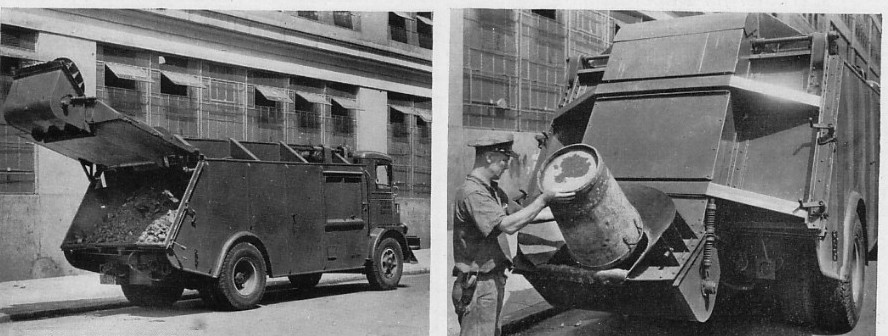
In March of 1937, even as these new enclosed-body trucks were being delivered, the Department had come up with a completely new self-loading design that would transform the fleet forever. Loron G. Kurtz and Carl C. Ottoson are credited with designing the new self-loading truck, for which they were awarded patents as co-inventors. A new policy in effect at the time allowed city employees to personally patent inventions created while on the job, so long as the city retained free rights to use the technology. Kurtz was Deputy Commissioner of the DSNY. Ottoson, a Swedish immigrant, was probably involved with the maintenance section at some level, since he later invented a truck tire removing press for the Department. Kurtz and Ottoson designed the new loader around the 24-yard hand loaded body, adding a novel chain-conveyor tailgate assembly that carried the refuse to the top rear portion of the body. The conveyor chains, turning continuously at 660 feet per minute, extended along the length of the roof and helped to distribute the load within the body. Refuse was carried up the conveyor, or escalator, and fell onto the floor of the body. As it accumulated, the chains along the ceiling carried in forward, trimming the load until the body was filled. Large side doors at the front of the body allowed hand-loading during the early part of the route before the body became filled, or for bulky objects that could not be fed into the conveyor.
INSIDE THE DSNY ESCALATOR LOADER
EARLY MODEL WITH DIRECT DRIVE CONVEYOR
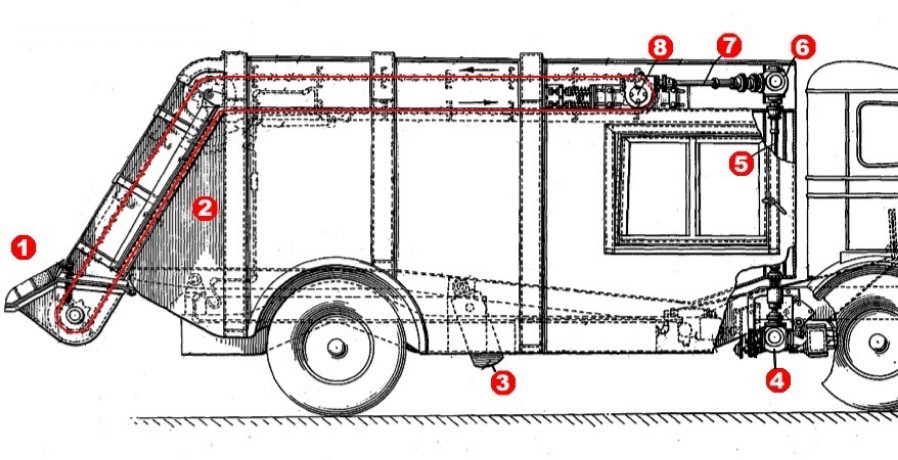
Red line highlights show path of roller chains and connecting flights within tailgate and body (1) Loading aperture where crewmen dump refuse into bottom of enclosed escalator (2) Rear of body, where refuse falls during first part of load. Once this space becomes filled, conveyor flights running atop roof begin to move refuse forward. (3) Telescopic lift cylinders for tilting body (4) Right-angle power take-off gearbox and coupler (5) Vertical driveshaft (6) Right angle gearbox (7) Horizontal driveshaft (8) Gear reduction and conveyor final drive, incorporating shock-absorbing spring tensioners for conveyor chains
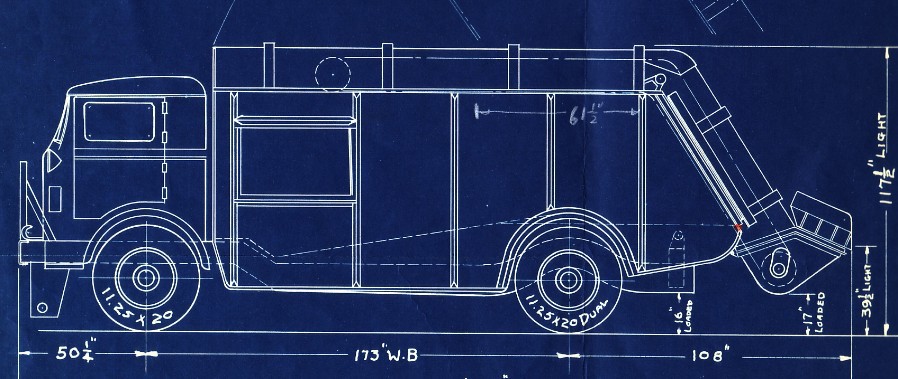
Dimensions for 1938-1939 Heil/Autocar escalator-loader. Click here to see the whole blueprint.
|
The new body design was not only self-loading, but featured a substantially lowered loading height of only 40 inches above ground level. The drop-frame chassis design contributed to the low loading height. This was seen as a way to reduce the high rate of physical injury that the Department had experienced with hand-loaded trucks. The tailgate assembly, which housed the escalator portion of the conveyer, was hinged to the upper body. During unloading, the tailgate was hoisted upward and clear of the body by twin hydraulic rams, located inside the body. On the first versions, the conveyor was driven directly by the truck engine via a power take-off, a clutch and then through several drive shafts fitted with universal joints, and a final-drive gear reduction box mounted on the roof. A self-aligning coupler allowed for separation of the driveline when the body was raised to dump. Body capacity of the escalator-loader was reduced to 21 cubic yards, owing to the space occupied by the conveyor mechanism.
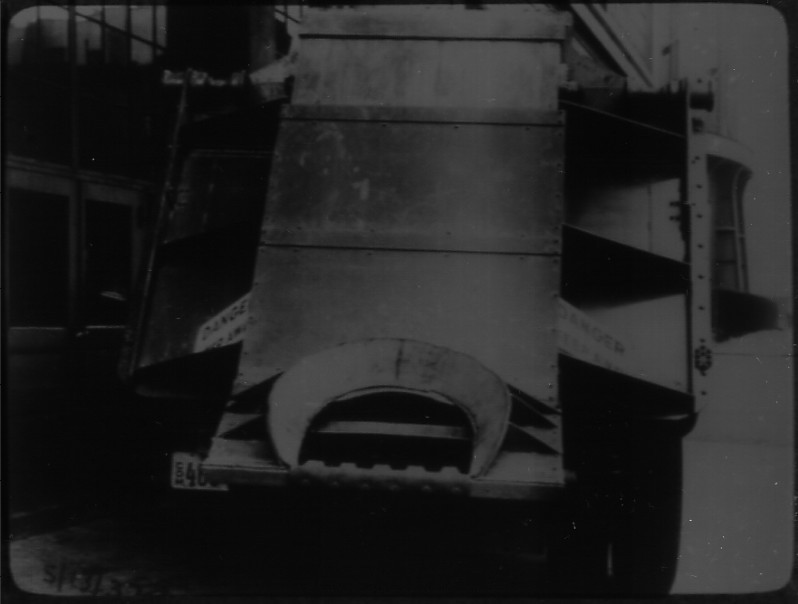
The earliest known photo of a DSNY escalator-loader, dated May 13, 1937. This may have been a "hand-built" custom, fabricated by the Department. One of the conveyor flights is visible within the round loading aperture.
|
The earliest known photograph of a DSNY escalator-loader suggests that a working prototype had been built by the winter or spring of 1937. This first model may have been built by Department personnel, by modifying one of their existing enclosed collection trucks or some other suitable body. What is believed to be the second prototype was built to DSNY specifications by The Heil Company, and was most likely constructed at their branch factory in nearby Hillside, New Jersey. Designated truck 287-357 by the Department, it is the only known combination of GMC chassis and Heil-built escalator loader. This second truck, with a 21-yard body was tested extensively on the streets on New York during the summer of 1937, and proved satisfactory in many ways. Since the load was distributed mechanically within the body by the conveyor, the enclosed body carried greater payloads. Tests showed the new unit could haul twenty-five percent more material than the 24-yard hand-loaded body currently in use.
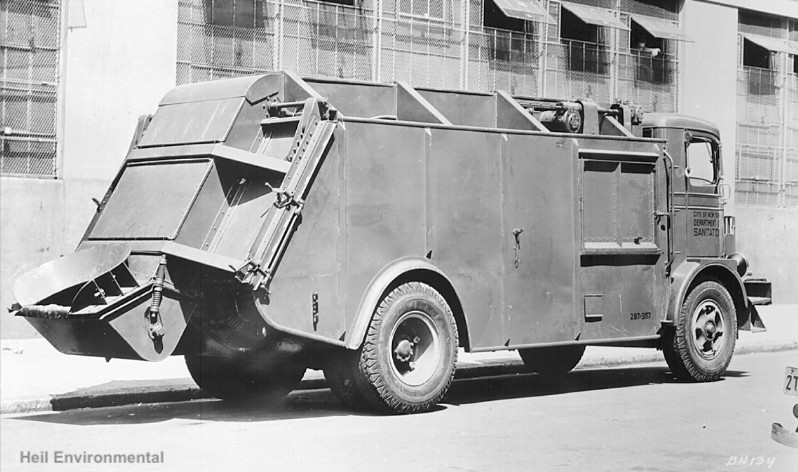
Truck 287-357 was a GMC with a Heil-built escalator-conveyor body, a.k.a. the 'second prototype'. This was the truck shown in early press releases, and tested by the DSNY during the summer on 1937. The tailgate bracing differs substantially from the truck in the May 1937 photo. Also, the bottom of the hopper (called the loading boot) was now detachable, and secured with heavy coil springs. This allowed it to "kick out" in the event of an object becoming jammed between conveyor flights and the boot. Also note the conveyor drive gear reduction unit mounted on the roof, just above the side-loading door.
|
Convinced of the merits of their design, the DSNY formally adopted the escalator-loader as their front-line collection truck. Though the Department operated state-of-the-art maintenance and repair shops throughout the city, it nevertheless had no capacity for the manufacture of bodies it so desperately needed. Contracts would be offered for the construction of the escalator-loader to be built from Department specifications. The first order for 300 complete new trucks was awarded to Gar Wood Industries, in June of 1937. The bodies were built in Michigan at Gar Wood's Highland Park factory, mounted on GMC T-series cab-over-engine trucks, and then driven to New York City. The body was made of high-strength Yoloy steel provided by Youngstown Sheet and Tube Co, Youngstown Ohio.
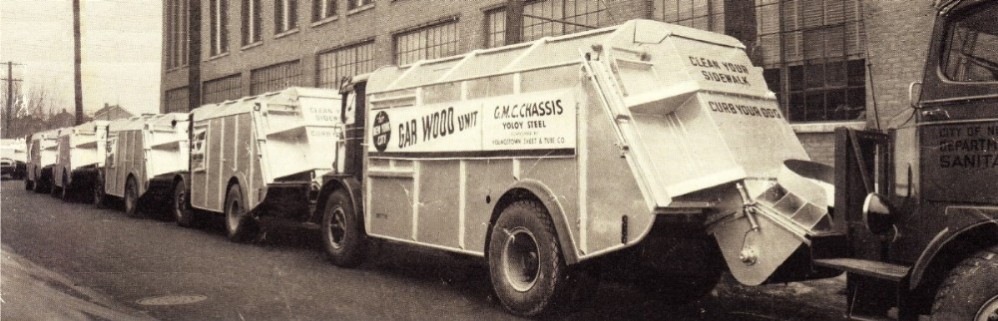
Part of original order of 300 Gar Wood DSNY escalator-loaders leaving Detroit for New York City in 1938
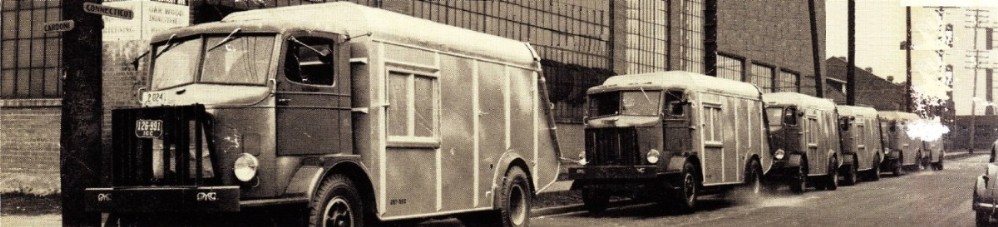
Part of later order of 153 Gar Wood units assembles at intersection of Cardoni and Connecticut Streets, Detroit, Michigan circa 1939
A subsequent bid for 207 more escalator-loaders was won by The Heil Company, and were built at built at the Hillside factory. Unlike the second prototype unit, all Heil-built escalator-loaders would be mounted on Autocar model UT cab-over trucks. Autocar was based in Ardmore, Pennsylvania, just west of Philadelphia and a mere 90 miles from Heil's Hillside facility. This undoubtedly helped Heil bid competitively, since transporting or driving GMC trucks out of Detroit would have been more expensive. It was an unusual situation in which two rival manufacturers were actually building the same body at the same time for the same customer. Since the refuse bodies were built to DSNY specifications, both Gar Wood and Heil versions appear identical. Therefore, the brand of truck on which a particular body is installed is the best means of identifying the body builder.
IDENTIFYING DSNY ESCALATOR LOADERS BY TRUCK MANUFACTURER
The DSNY escalator-loader was built for the Department by Heil and Gar Wood. Both versions of the body were virtually identical from year-to-year, making identification difficult. Knowing what truck the body is mounted on is a relatively accurate means of differentiating the two:
Heil bodies were mounted on Autocar UT series cabover trucks
Gar Wood bodies were mounted on GMC T-73 cabover trucks
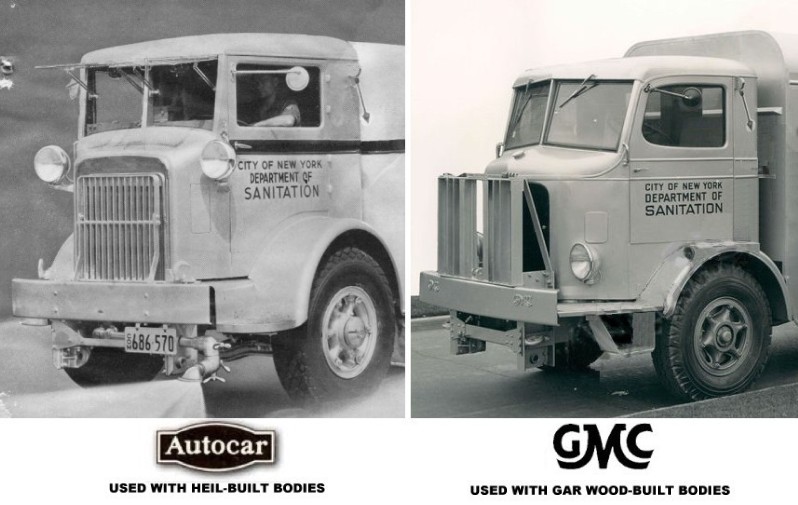
The most noticeable differences are the shapes of the side windows, and the front fenders: Autocar fenders are wide and fully curved, while GMCs are narrower with flattened tops to clear the lower edge of the door. Also note that the GMC has a slightly "V" shaped windscreen, and twin ribs wrapping around the sides of the cab.
The height of the freestanding headlamps may be misleading. Most of the DSNY Autocars have the high-mounted style shown above, but examples do exist with the lights in the lower position as on the GMC. Since these trucks were typically equipped with snowplows, lighting arrangements may vary considerably.
|
Kurtz and Ottoson made several improvements to their design. The biggest change was implemented in 1939, when a hydraulic motor was used to power the conveyor, eliminating the complex mechanical drive of the first production units. In addition to simplifying the driveline, jam-ups in the conveyor were reduced by installing a pressure relief valve to bypass the fluid in the event of a stoppage. If a jam-up did occur, the operator could easily reverse the direction of the conveyor at the control valve. The upper portion of the truck body was now covered with curved metal panels, as was the tailgate, which protected the unit from weather and gave the body a more streamlined appearance. Inside the body, resilient conveyor flights were introduced in 1940, spring-loaded to allow them to ride up over obstructions. The idler sprockets and transverse shaft in the base of the loading boot were eliminated for 1941, and replaced with special formed guide ways for the chains. This change eliminated the problem of wire and rope becoming entangled in the transverse shaft, and increased the useable loading area in the boot.
By June of 1939, there were a combined total of 674 Heil and Gar Wood escalator-loaders in service. The total number of units that were eventually built probably exceeded 1,500 units. A third company, Highway Trailer of Wisconsin, is also believed to have built at least one unit on a GMC chassis, though this fact cannot currently be verified. Purchases were conceivably made each year until 1942, at which point both manufacturers were most likely switching over to war production. It is unclear if any escalator were ordered or built after the war, however it is noteworthy that the DSNY still had 624 units in service as late as 1951, consisting of 154 Gar Woods with hydraulic-drive, 281 Heils with hydraulic drive, and 189 of the shaft-drive Heil models from the late 1930s. These robust loaders obviously served the city well over a decade or more of service. The DSNY had been wise in initiating their fleet upgrade in 1936, since the war would have made such a program impossible during the 1940s.
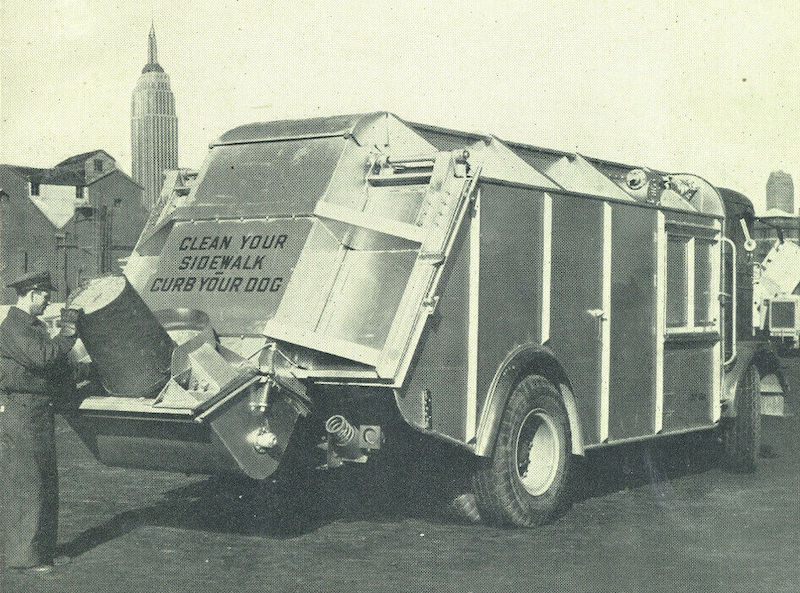
An early model Gar Wood loading demonstration
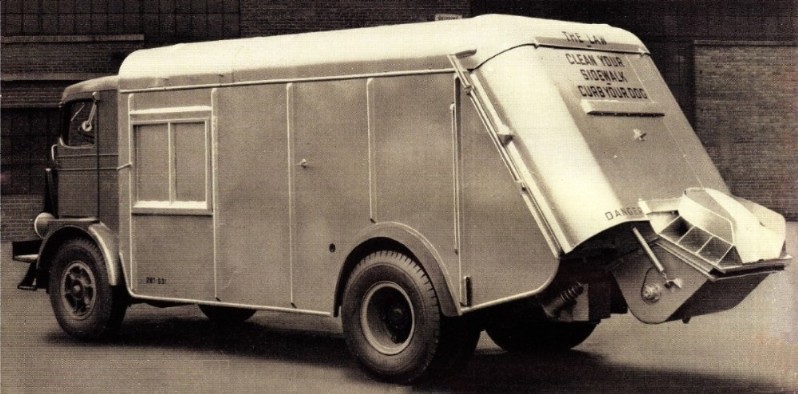
Improved DSNY escalator-loader at a Gar Wood facility in Detroit, Michigan
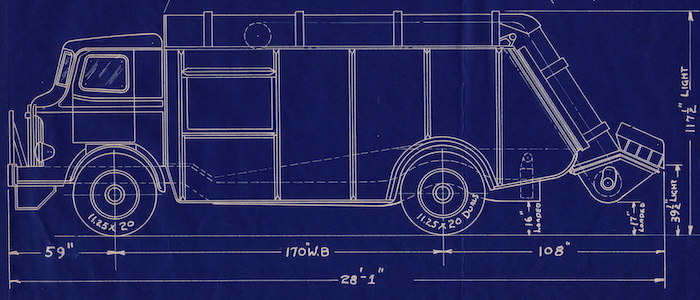
Dimensions for the 1940 Gar Wood/GMC escalator-loader. Click here to see the whole blueprint.
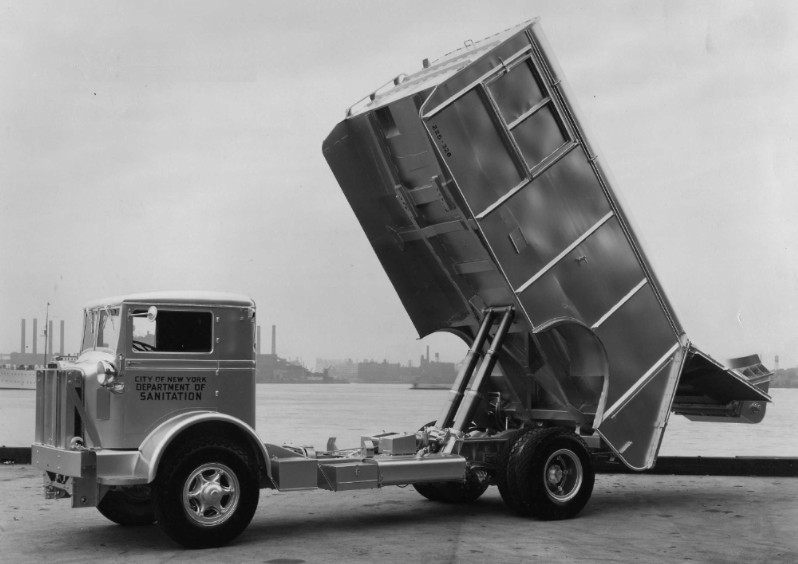
1939 Heil-built model demonstrating 55-degree dump angle and twin-cylinder hoist. The 173" wheelbase Autocar model UT chassis is lowered just behind the cab, reducing overall height. Body is fabricated from corrosion-resistant Mayari R alloy sheet produced by the Bethlehem Steel Company of Bethlehem, Pennsylvania.
|
With the adoption of the escalator-loader, the DSNY became the first American city to initiate a major fleet conversion to mechanically loaded refuse bodies. While not a true compactor, it was a vast improvement in efficiency and safety over previous collection methods, and the publicity undoubtedly piqued the interest of many other towns and cities. If industry had been unsure of the sales potential of self-loading refuse bodies, the sheer number of units ordered by the DSNY surely took care of any doubts.
Both Gar Wood and Heil would go on to become titans of the refuse body industry, but would move in different directions after this brief crossing of paths. Gar Wood was introducing an all-new hydraulic packer body even as they were filling the first orders for DSNY escalator-loaders in 1937. After the war, their Load-Packer series would be positioned perfectly to capitalize on the pent-up demand for modern refuse equipment, and dominated the market. After fulfilling their DSNY contracts, Gar Wood was never again involved with escalator/conveyor type bodies.
However, Heil stayed with the escalator concept, introducing their own improved version in 1938, which was sold under the Heil name. At least two major cities, Milwaukee and Chicago, adopted the Heil Conveyor. Heil also continued making bucket loaders, eventually acquiring the Colecto brand outright in 1945. It was not until 1953 that Heil abandoned these self-loading bodies for their own hydraulic rear-load packer, the Colectomatic.
The DSNY made their first break from the escalator-loader in 1950, buying several hundred Gar Wood hydraulic packer bodies. Gar Wood's relationship with the DSNY would be short-lived, with the Department specifying an all-new escalator-compactor body the following year. The Roto-Pac, built in Queens by City Tank Corporation had recently been redesigned, and was the only production body meeting the new specification. Roto-Pac became the most popular DSNY refuse body well into the 1960s. Its continuously loading conveyor with augmenting packer plate was the logical progression of the old escalator-loader, and was probably created solely to capitalize on the DSNY's preference for these types of trucks.
Though their numbers dwindled due to attrition, some of the old escalator-loaders, as well as a fair number of the hand-loaded 24-yard enclosed bodies survived into the 1950s and beyond. Beginning in 1949, the DSNY even converted some of the latter to packer trucks by adding Load-Packer or Roto-Pac tailgates. Many were converted to other uses, such as vacuum leaf collectors or for animal carcass collection. At least one Autocar UT was still in use in 1964 for hauling dead horses, after almost 30 years of service!
LIFE AFTER RETIREMENT: DSNY EQUIPMENT CONVERSIONS
The DSNY sanitation trucks of the late 1930s that had out-lived their original purpose were sometimes modified to perform special jobs, usually seasonal or occasional in nature:
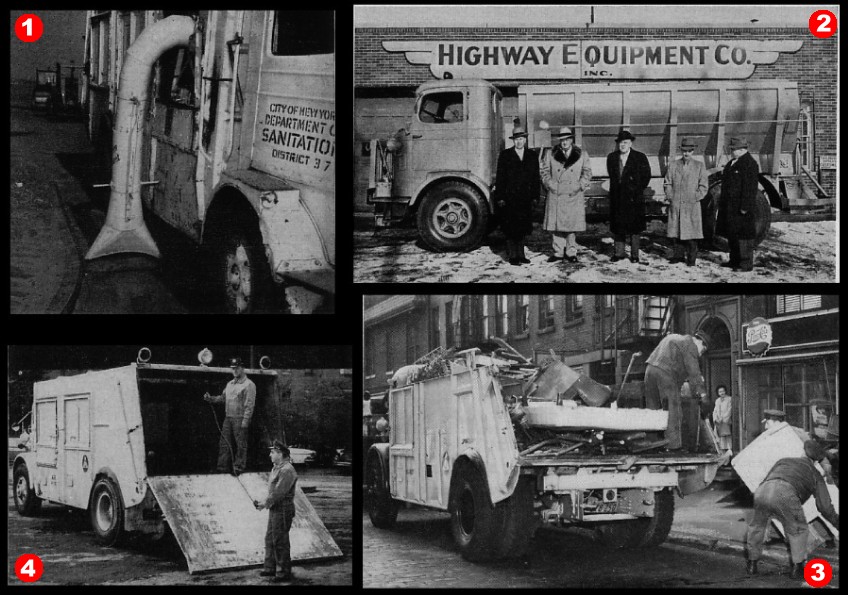
(1) GMC with 24-yard refuse body converted to vacuum leaf collector in 1951. (2) GMC with body removed and replaced with Highway rock-salt spreader in 1953. (3) Autocar/Heil escalator-loader with tailgate removed and body chopped, on bulk collection in 1956. (4) The DSNY's duties included removing dead horses from city streets. This 1930s Autocar with a 24-yard refuse body converted to an animal hearse (1964)
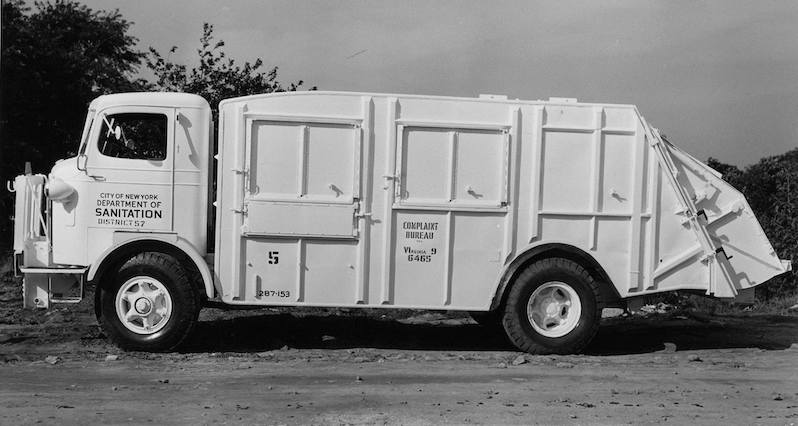
During the late 1940s, a small number of the 24-yard enclosed bodies purchased in the 1930s were converted into packer or self-loading trucks. Gar Wood Load-Packer tailgates were installed on 101 units, such as the 1948 conversion shown here. Another 62 units are known to have received Roto-Pac rotary-crusher type tailgates. (Waste Pro Museum)
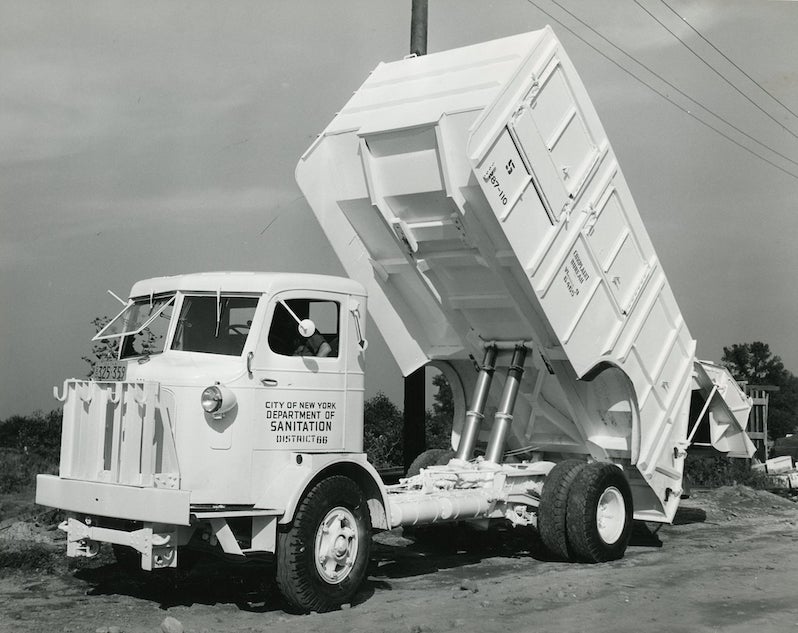
Although these conversions were not regular production models, they were the largest rear loaders in service at that time, pre-dating Gar Wood and Leach models of the mid-1950s.(Waste Pro Museum)
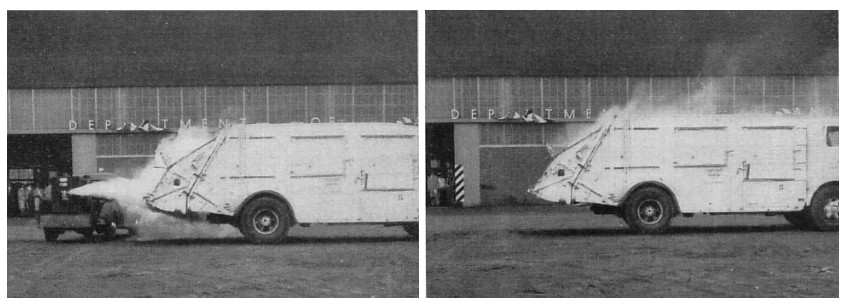
The Gar Wood conversion above is being treated with a disinfecting fog after being washed.
|
PATENTS:
|
Patent # |
Description |
Inventor |
Assignee |
Date |
|
US2266770 |
Self-Loading Truck |
Kurtz, et al |
|
July 31, 1937 |
|
US2194475 |
Loading Boot |
Kurtz, et al |
|
May 19, 1938 |
|
US2224789 |
Refuse Collecting Truck |
Kurtz, et al |
|
February 13, 1939 |
|
US2266645 |
Mounting for Endless Conveyors... |
Kurtz, et al |
|
May 9, 1940 |
|
US2307139 |
Flight Mounting |
Kurtz, et al |
|
August 28, 1941 |



7/30/14
© 2014
All rights reserved
Photos from factory brochures/advertisements except as noted
Logos shown are the trademarks of respective manufacturers
|
| |