
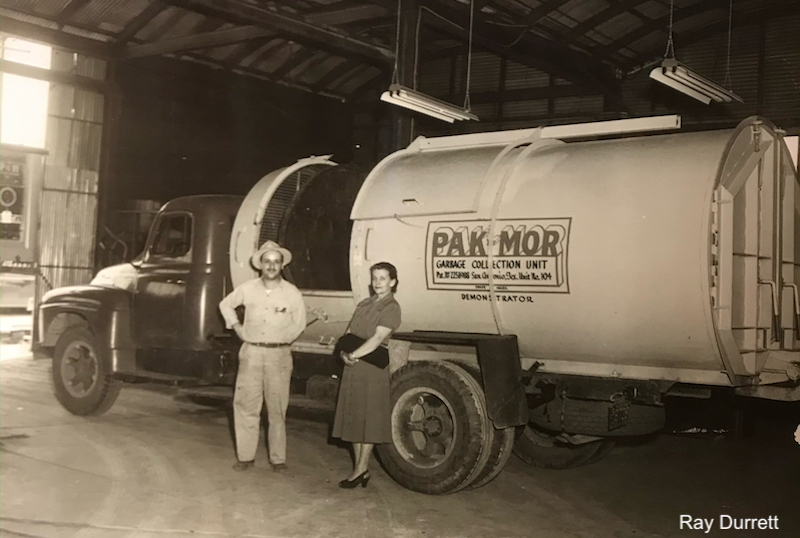
A rare old photo of a Pak-Mor demonstrator unit, serial #104, on International Harvester truck chassis, circa 1947-49. Pictured at left is Pak-Mor engineer William A. Ferrari and co-founder Effie May Thurmond
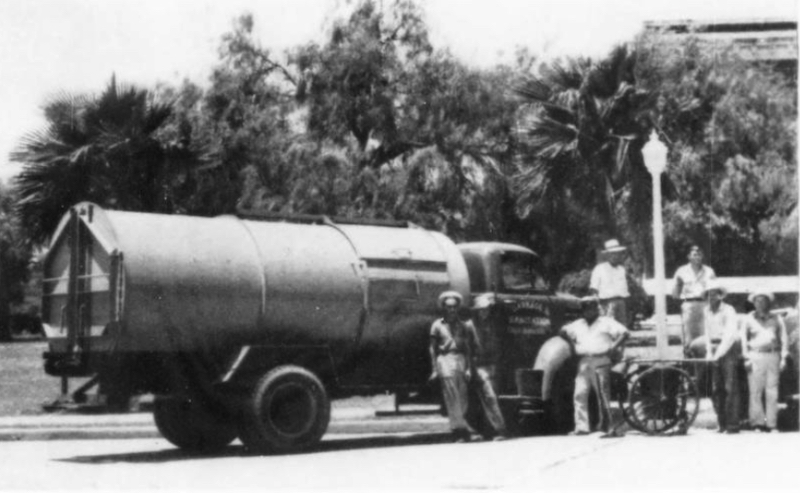
One of the first official Pak-Mor bodies was this 18-yarder sold to Raymondville, Texas in 1948 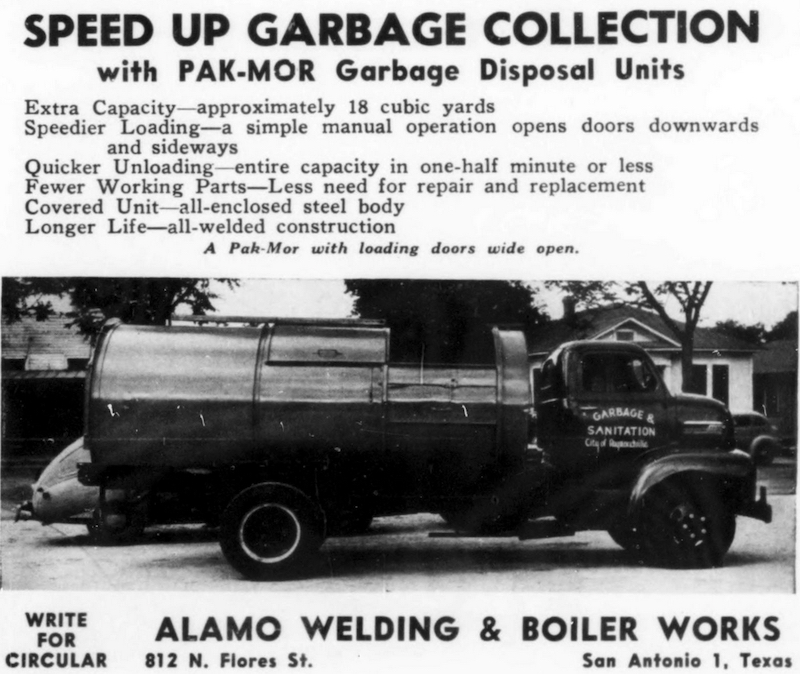
1948: The first known trade ad for the new Pak-Mor, featuring the truck sold to Raymondville 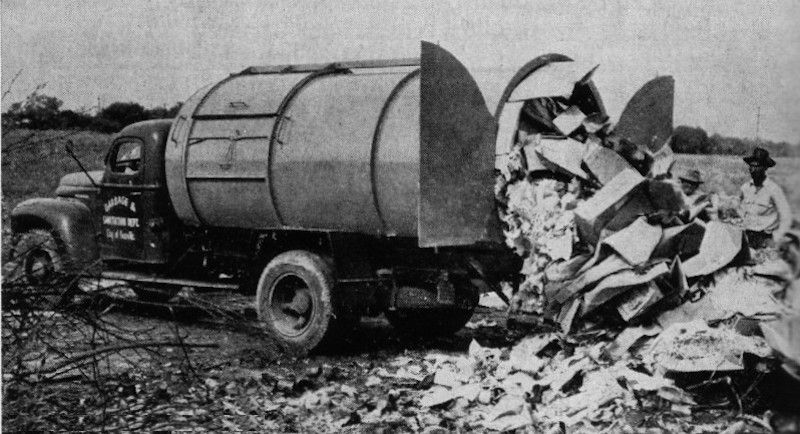
1949 Pak-Mor discharging its load. The full travel packer blade allowed for 'no-tilt' unloading, a tremendous advantage over the rear loaders of that era. That same year, Pak-Mor unveiled what was then the world's largest refuse truck, a massive 30-cubic yard semi-trailer side loader. It was essentially the same as the 9, 12 and 15-yard truck-mounted versions, but was independently powered by a 95 horsepower Ford auxiliary engine. With its own powerplant, the big trailer could be detached from the truck tractor and left 'on-site' as a stationary packer. Many would be adapted for use as refuse transfer trailers. High loading sill heights were one of the few disadvantages that standard side loaders had. However, these big semi-trailer versions stood substantially lower than their truck-mounted brethren, allowing for lower loading heights, on par even with rear loaders. Thus, the trailer versions would eventually be identified as the Pak-Mor Lo-Boye. 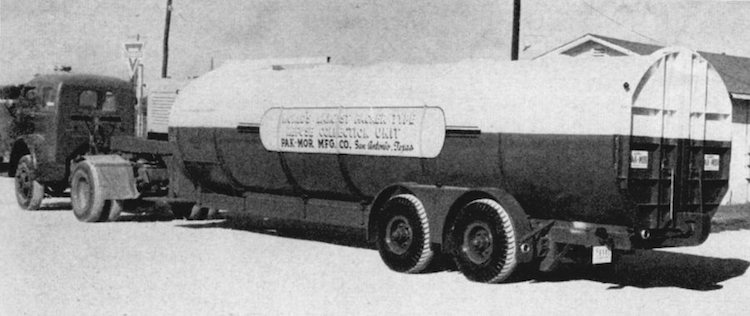
1952 Pak-Mor 30-cubic yard trailer. The idler sprocket for the endless loop roller chain can be seen protruding beyond the rear doors 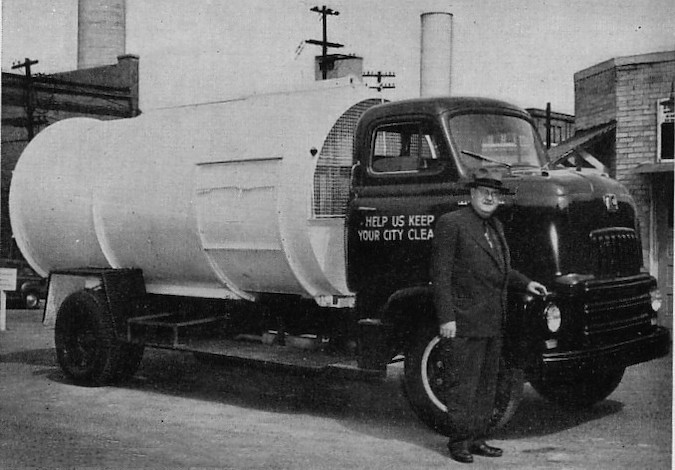
1951 International cabover for Little Rock. These early bodies were technically 18-cubic yards, but sometimes were labeled as 15-yards, probably by the subtraction the frontal hopper area. 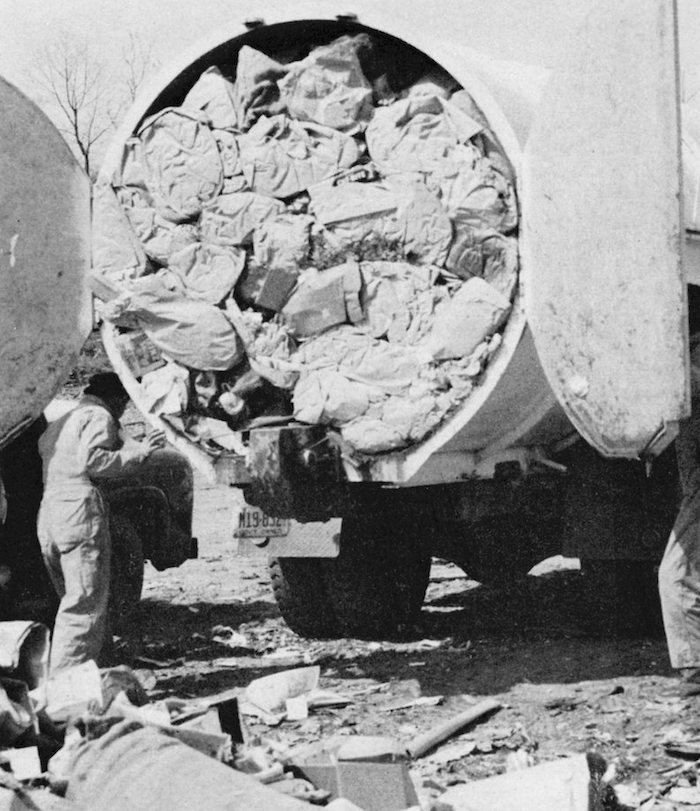
Pak-Mor's motto was "the proof is at the dump", as illustrated by this truck readying for discharge at a landfill outside of Fredericksburg, Virginia 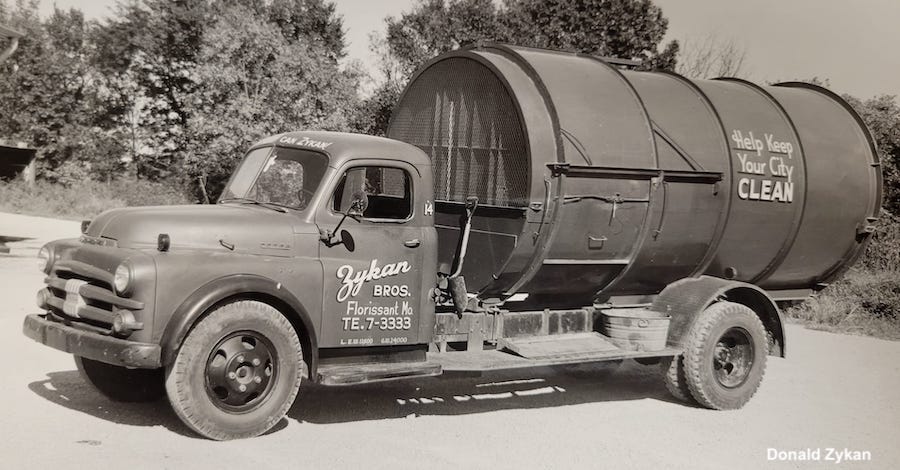
Early 1950s Dodge/Pak-Mor I-series owned by Zykan Brothers, a St. Louis contractor 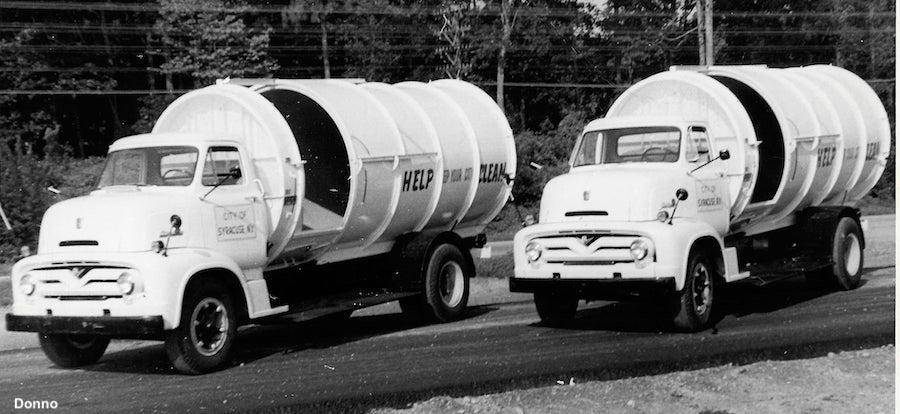
Pair of I-series on Pak-Mors on 1955 Ford cabovers bought by the City of Syracuse, New Yprk 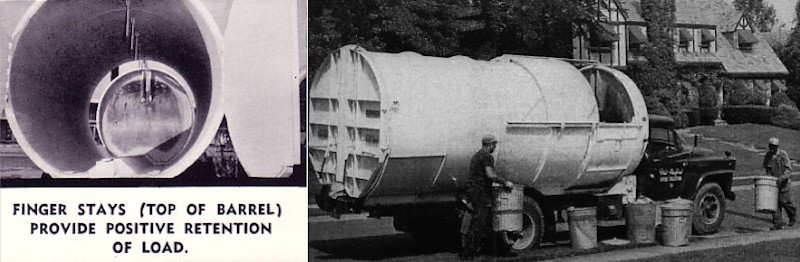
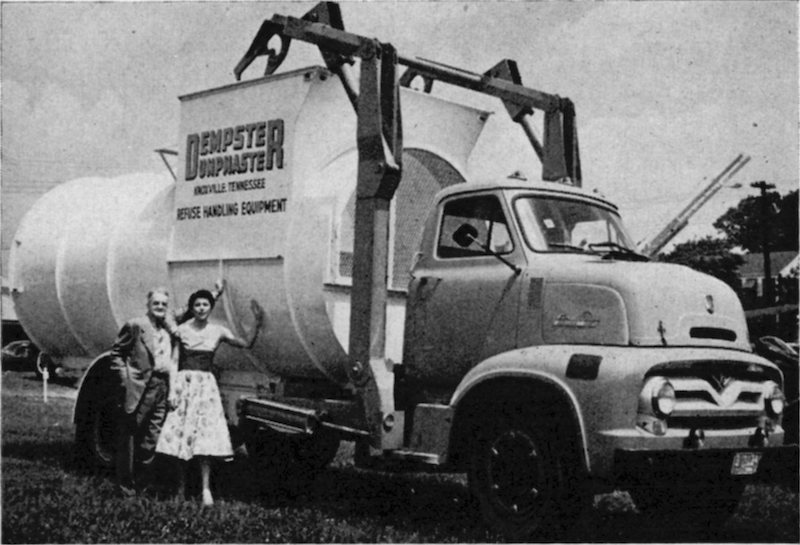
When Dempster displayed their Dumpmaster Front Loader at the July 1955 APWA show, it was feeding a Pak-Mor body with a customized top opening 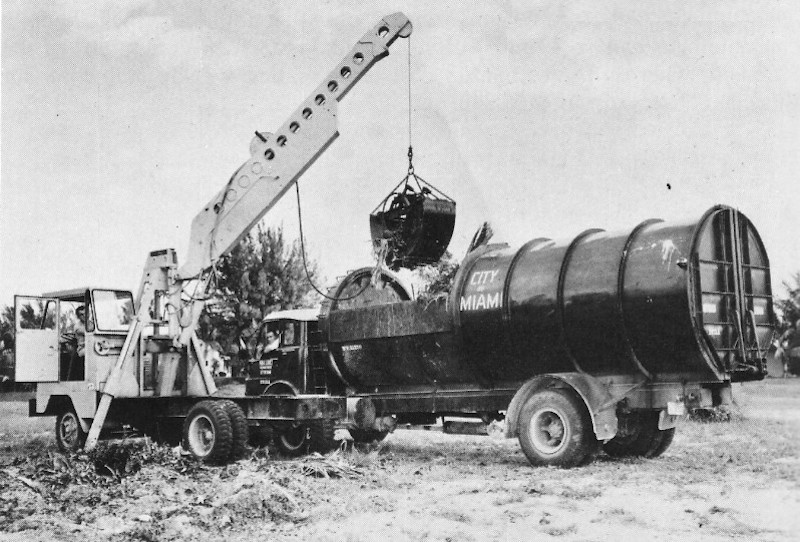
The Pak-Mor circular body could be configured various ways, such as this custom "top loader" used to collect Palm fronds by Miami, Florida 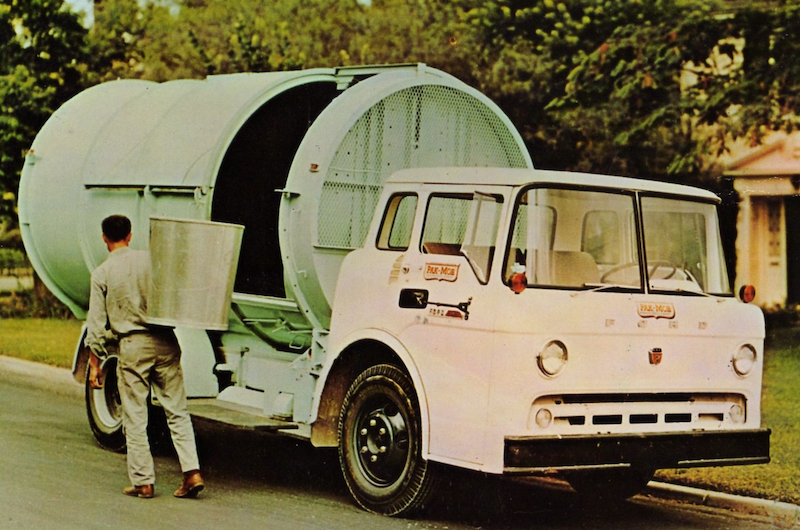
1957 Pak-Mor demonstrator on a Ford C-series tilt cab 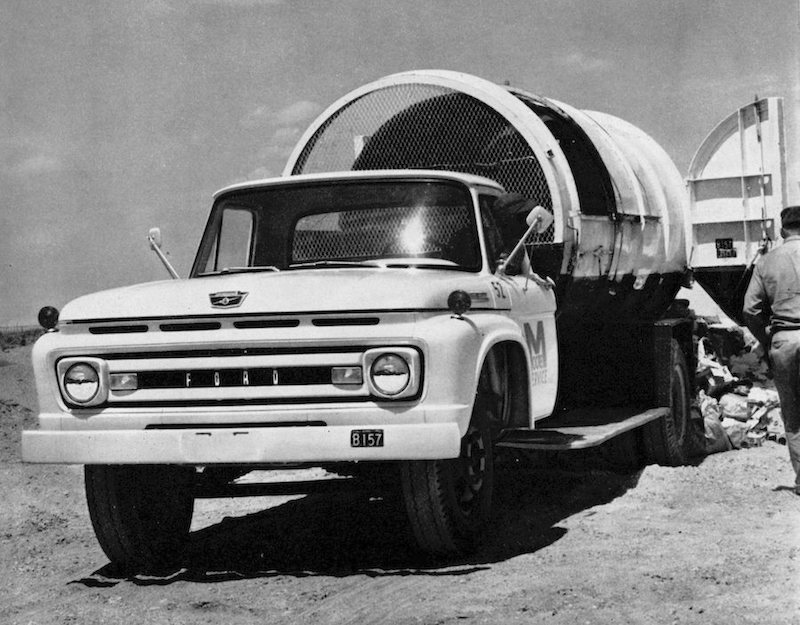
1962 Pak-Mor on a Ford F-600 owned by Moore Sanitation of El Paso, Texas; one of the last of the chain-drive models SELECTED PATENTS
|