
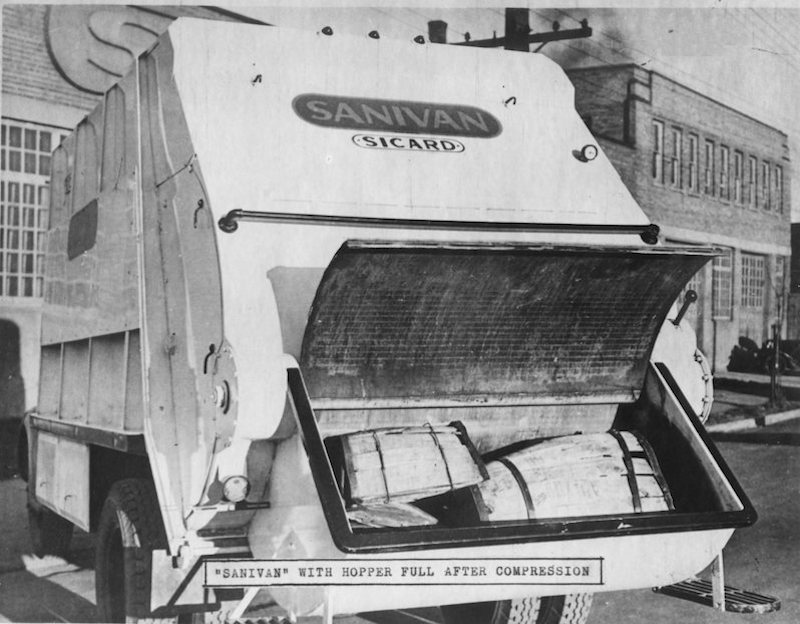
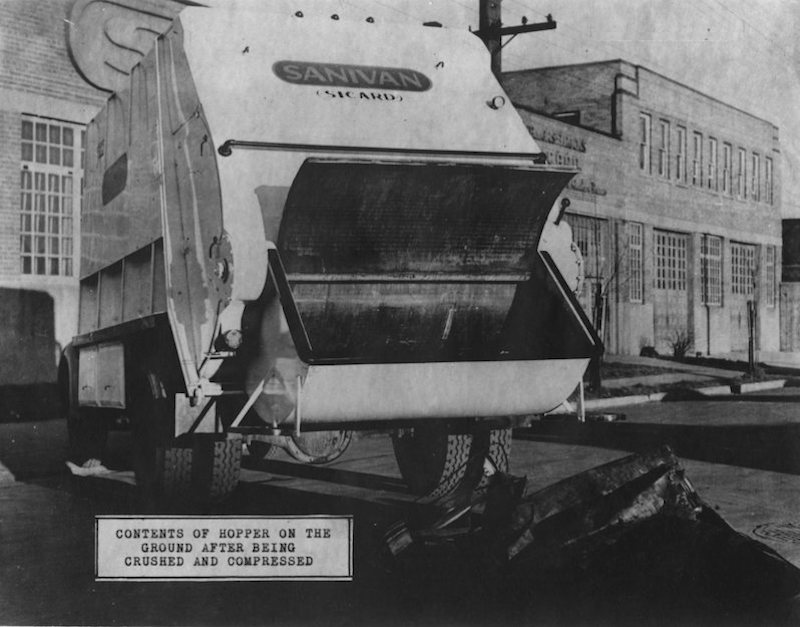
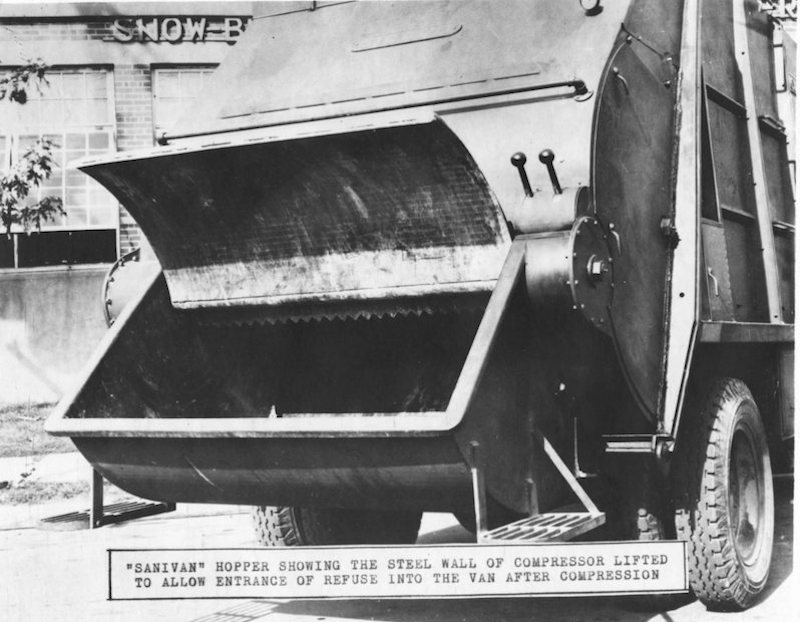



SM-3 Sanivan (continued)
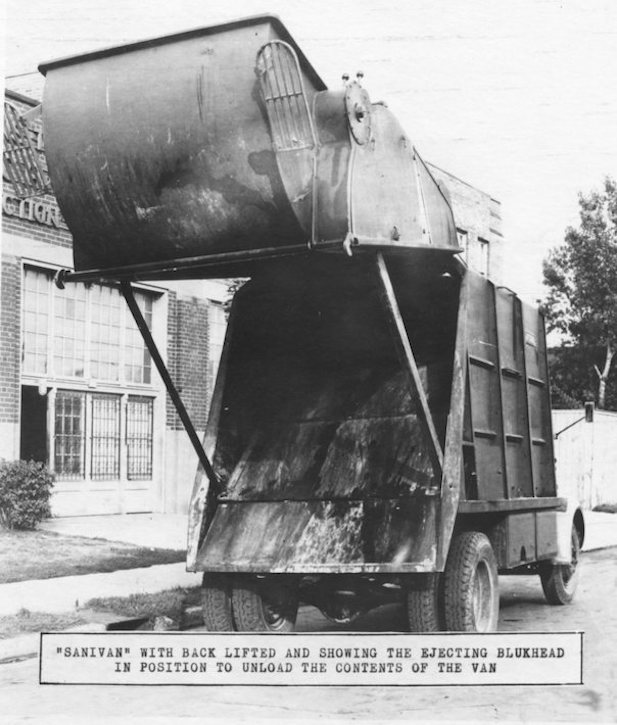
The problem of unloading: 
The rear load packer truck was itself a fairly new design in 1945, and ejection unloading was only used in a few side loading, moveable partition designs such as Marion and Pak-Mor (the latter also being a then-new model). Early refuse trucks had typically used hydraulic tipping to unload, just like a standard dump truck. Tipping is well suited for dump trucks, which haul heavy, dense material (such as rock or earth) which will easily discharge when the bed is elevated.
Refuse packer trucks however, hold comparatively light loads that are stuffed tightly into the body. When tipping, the weight of the truck's engine and forward chassis tended to counter that of the load...most of the time. If the weight and density of the load were excessive, the balance was shifted rearward and the front wheels of the truck chassis could come off the ground, stranding the vehicle on it's back.
The taller refuse body has a high center of gravity, even more so when the loaded body is raised. This is further aggravated by the weight of the tailgate structure, raised high above the body during unloading. Since refuse trucks frequently unload on the notoriously poor footing of sanitary landfills, the danger of capsizing was all too real. Capsizing was not only dangerous to the men, it obviously was damaging to the truck and body as well.
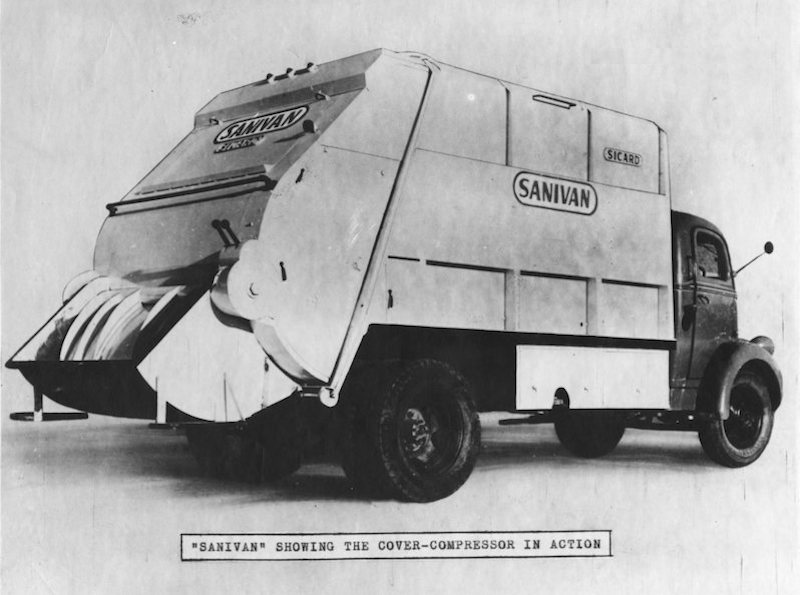
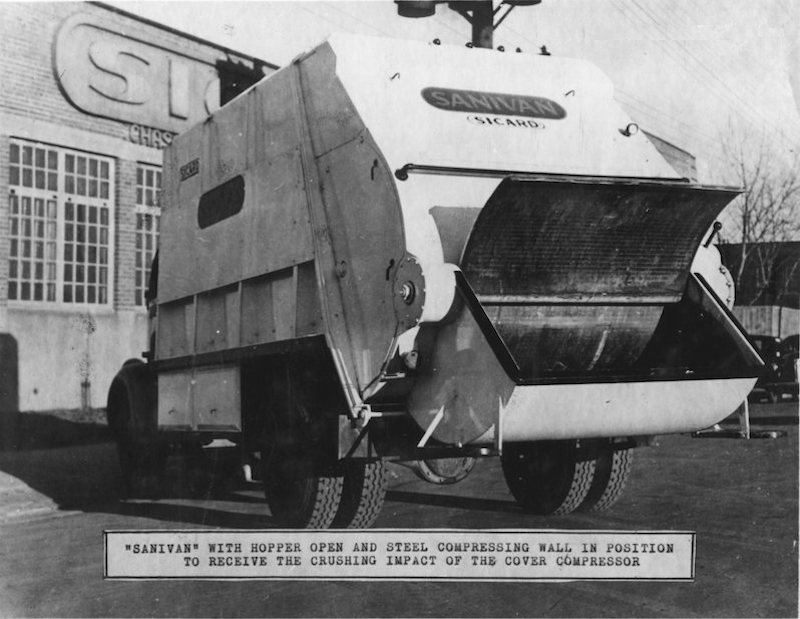
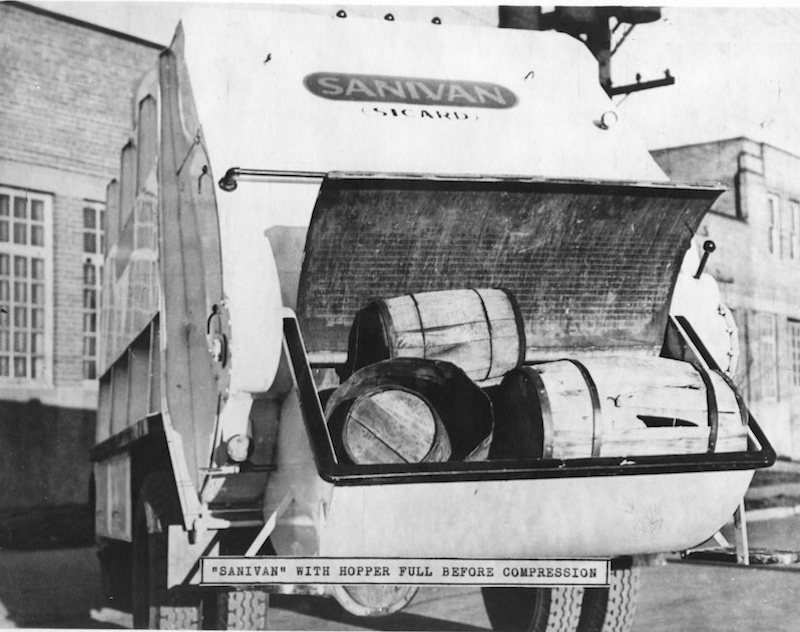
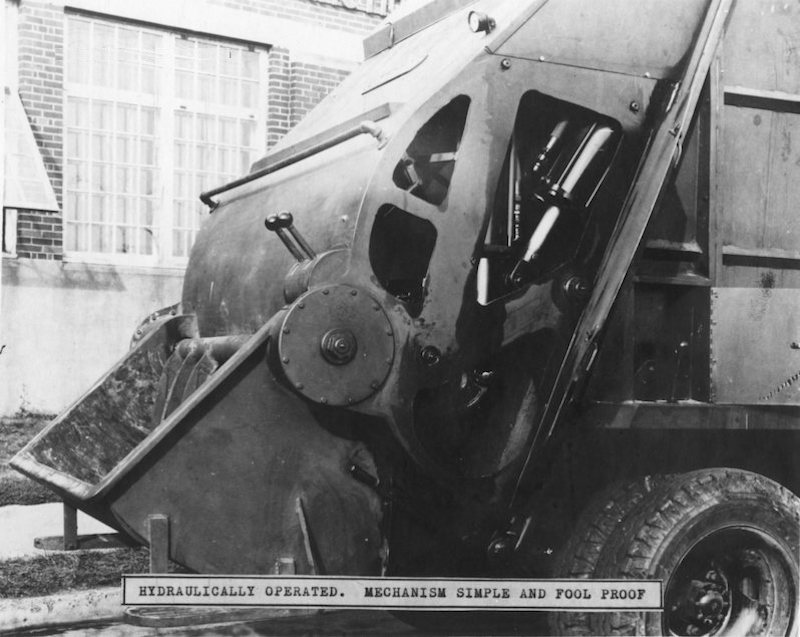
Since the Sanivan has not been made for nearly fifty years, it is often overlooked as the first rear loader to address this problem using hydraulic ejection discharge. Sicard also pioneered the use of twin cross-mounted hydraulic cylinders, a feature which has recently been used on some modern front loaders.
Figure 1: Loading Position (side, top views)
Cutaway drawing shows folding ejector panel fully retracted at the front of body, ready for loading to commence. Three panels 1A, B, C hinged to each other form a barrier within the body. The uppermost panel is pivotally connected at the roof 2 and bottom section is connected to twin hydraulic cylinders 3A, B mounted to the front of the body. Note in the top view how these offset, cross mounted cylinders stow away neatly in the space ahead of and and beneath panel 1C. There is relatively little "dead space" in front of the ejector panel assembly. A set of push bars 4 are connected on one end to the lower ejector panel 5. Rearward end of each push bar is rounded 6, and bars lay horizontal on either side of the body floor.
Figure 2: Unoading Position (side, top views)
To unload, the tailgate clamps are first released manually by the operator. Then, by pulling a single control lever, the hydraulic cylinders 3A, B are pressurized and begin to slide the lower ejector panel 1C rearward. After a traveling a short distance, push bars 4 contact tailgate structure at 6 and begin to force it up and away from the body. As the cylinders continue extending rearward, the upper sections of the ejector panel 1A, B are pulled along with by lower section. At the full rearward extension, the tailgate is propped fully open, and the three sections of the ejector form a flat surface, disposed at a steep angle which allows any remaining refuse to fall away by gravity.
Figure 3: Unoading Position (3D view)
Three-dimensional rear view illustrates sloped surface that is formed by three panels 1A, B, C after full rearward extension of the assembly, as push bars 4 hold tailgate open. Also note adjustable seals at outboard ends of panel sections 7, as well as box-bracing to strengthen body 8, another feature that was to foreshadow modern refuse truck design.
By the end of the 1950's, several side and front load models were using multiple-stage telescopic cylinders for packing and ejection functions, and in 1960 Heil would use a hydraulic ejection panel in their Colectomatic Mark II rear loader. The use of twin single stage cylinders in the SM-3 sanivan may have been for economy, or perhaps due to the lack of availability of double-acting telescopic cylinders at the time. Regardless, Sicard had built a highly advanced design for it's time, and the first rear load packer to seriously challenge Gar Wood.
Next: The SM-4
11/6/04
© 2004 Eric Voytko
All rights reserved
Photos from factory brochures/advertisements except as noted
Logos shown are the trademarks of respective manufacturers
|
|