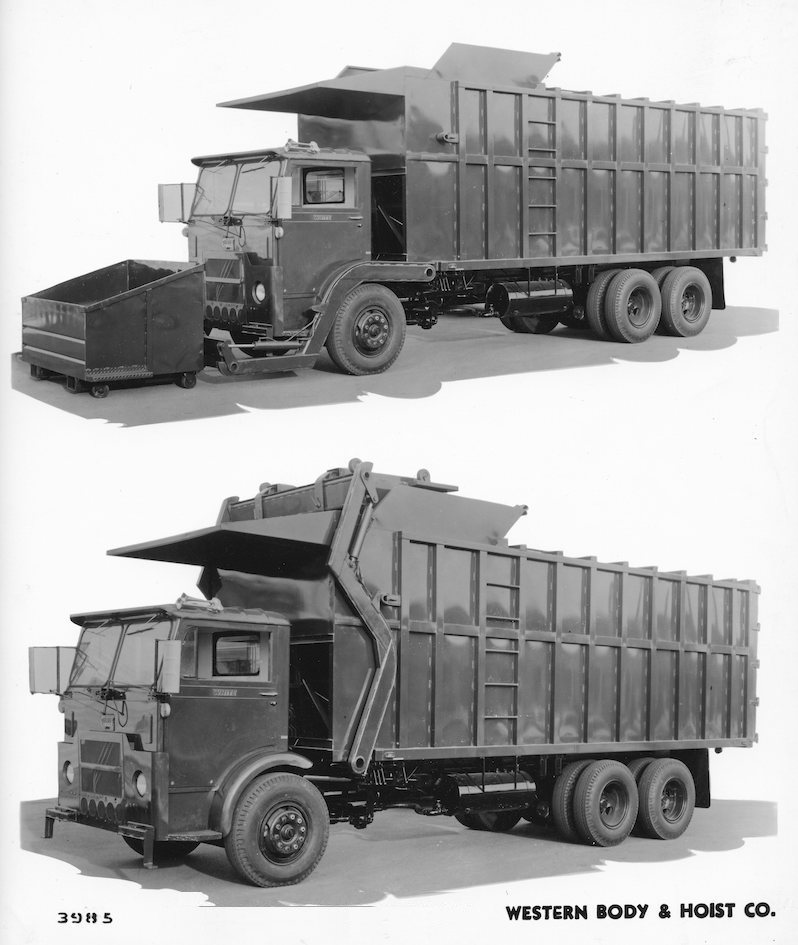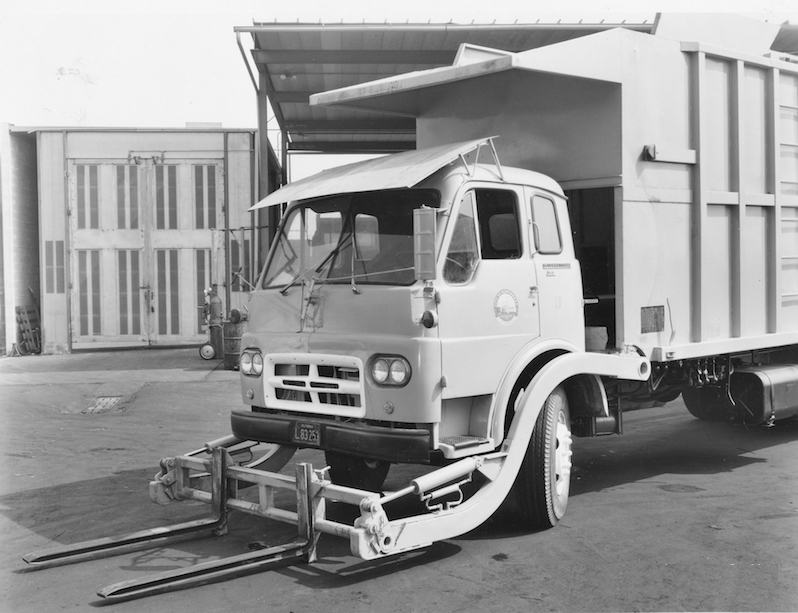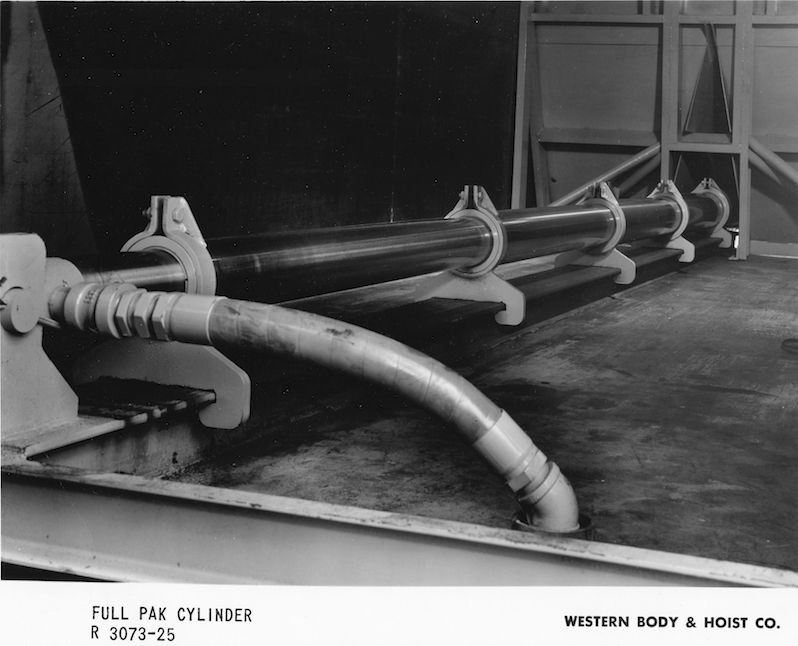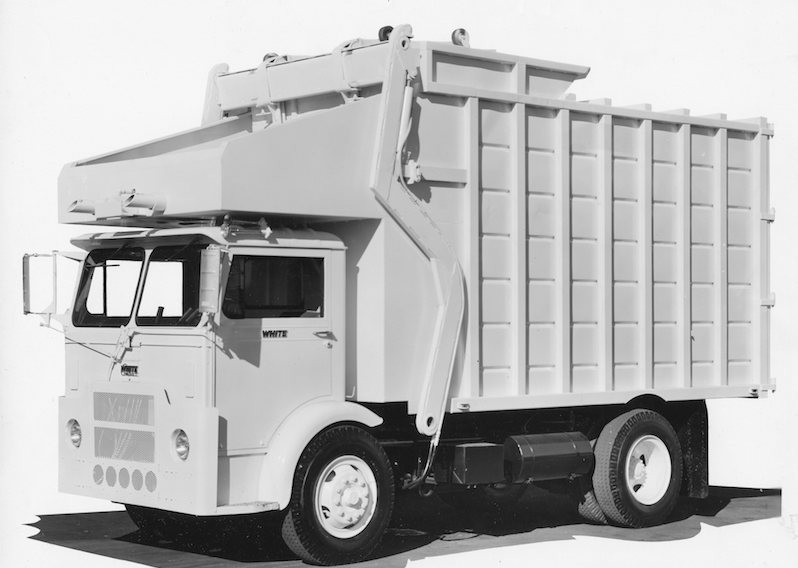

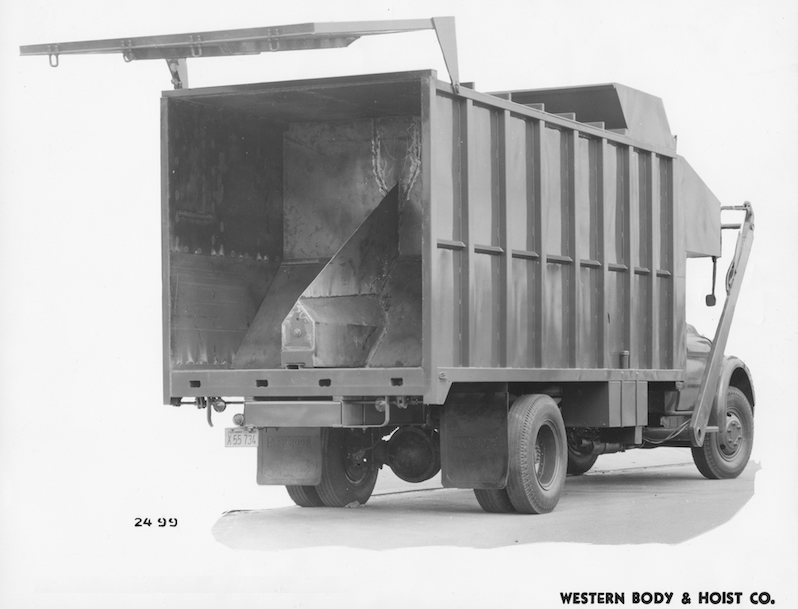
In 1958, Western & Body Hoist acquired the A&P Body Company, a Los Angeles-area firm producing a highly advanced compaction front loader. Western continued this design with few changes, and renamed it the Full-Pak. The above picture, from 1960s Western literature, is actually an A&P-built model, as their name appears on the mud flap next to the 1956 license plate. The origins of A&P remain a mystery, and this is the only known photo of an A&P-built body (sincere thanks go to Dana Gregory for preserving this piece of history). Clearly, it was far ahead of its time, and just what Western needed to compete with rival front loaders from Bowles, as well as Dempster. It used a horizontally-mounted, 5-stage telescopic cylinder for packing and ejection, which protruded into the face of the packing blade. The end gate on this model is hinged at the top, and is pushed open by the load, then held partially open by the ram protrusion (which can be extended past the rear edge of the body floor) to ensure complete load ejection. Lifting was still accomplished with the usual straight arms with a tilt-type fork carriage shaft. What appears to be a type of hopper cover resides atop the body opening. Also visible is the outside rearview mirror. This mirror may not have been retractable, since the arm width is greater than that of the body itself. The Full-Pak would develop a reputation as a rugged yet relatively lightweight packer. 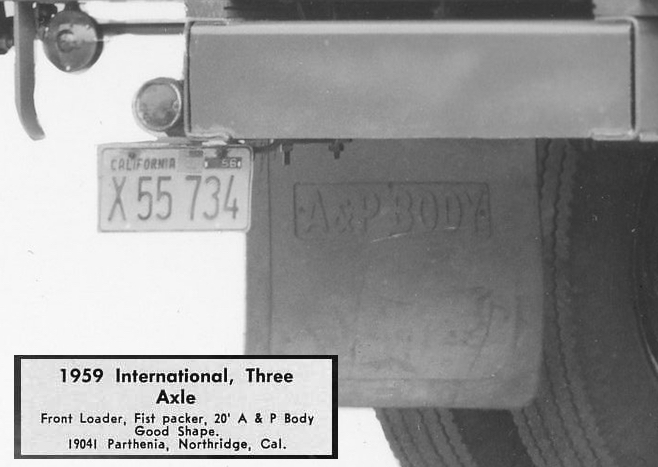
Above is a close up of the mudflap from the early Full-Pak, which bears the name "A & P Body". Inset within the photo is a 1964 classified ad for a used A & P "Fist Packer". The California plates clearly show a 1956 sticker. The origin of the name "fist packer" is not certain, but may have been inspired by the shape of the packer blade, which looks as if someone had punched their fist through it. Scott Blake recognized the seller's Northridge address as that of Granada-Sanchez Disposal, a longtime user of Western Full-Pak bodies during the 1960s. (UPDATE: 7/23/2022) Although purely speculative, the "A" in A&P Body may refer to Michael Ambarcumian (1912-1996), a mechanical engineer from Los Angeles. Ambarcumian filed two patents for truck equipment in the late 1940s, including one for Cook Brothers, a company that produced some of the first west coast front loaders. Even more intriguing, he filed a 1957 patent for a front loading refuse truck lift arm, and though this patent seems to have no connection to the A&P front loader, it does at least point to his involvement in the industry. Hopefully, this information may be confirmed in the future. 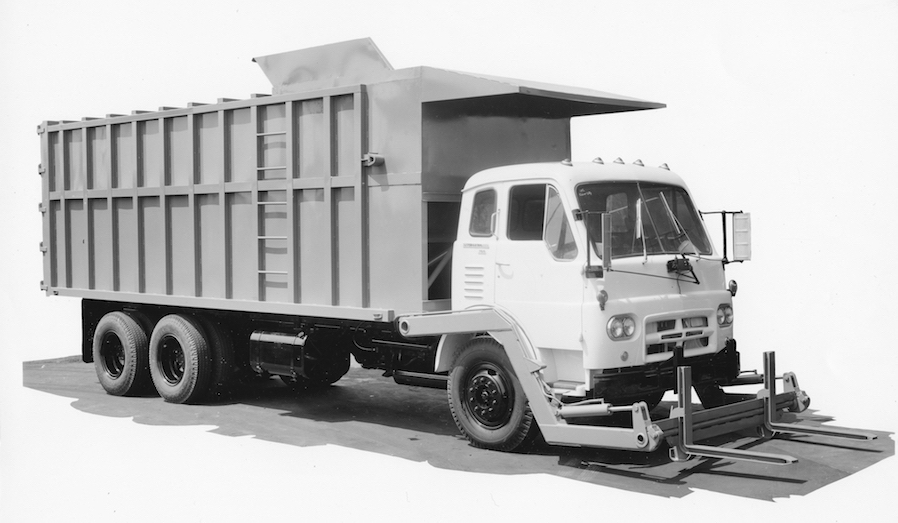
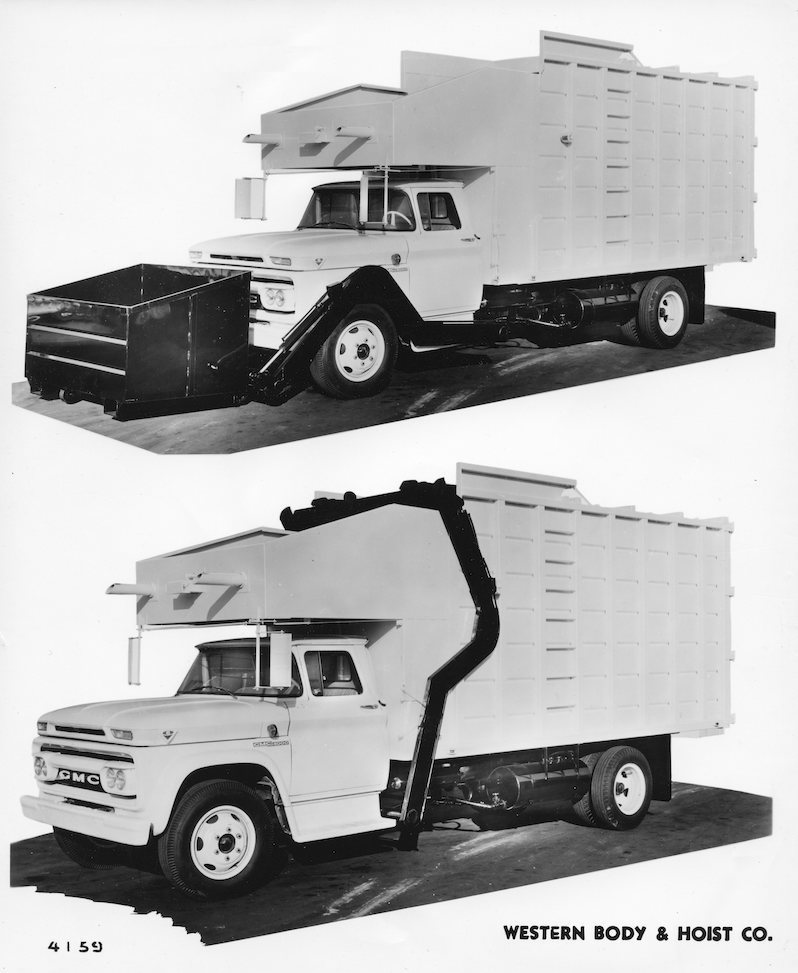
This early 1960s Full-Pak sports more modern over-wheel lift arms, a beefed up body, retractable mirrors and barn doors in place of the top-hinged gate 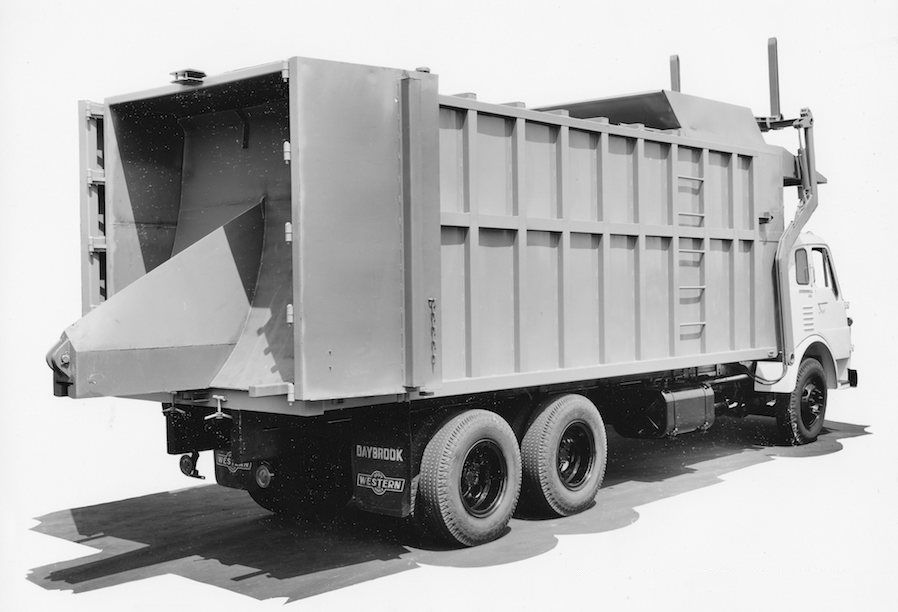
The discharge end reveals a bigger ram protrusion made necessary by the larger swept area of this high-capacity body



9/9/18 © 2018 (updated 7/25/22) All Rights Reserved Photos from factory brochures/advertisements except as noted Logos shown are the trademarks of respective manufacturers |